
MASTER YOUR MIND™ | HALF-DAY CORPORATE WORKSHOP
SHARPEN YOUR PEOPLE'S THINKING. BUILD A STRONGER WORKFORCE.
Overthinking, overwhelm, analysis paralysis and unchecked assumptions don't just affect the individual. They cost the business.
Master Your Mind™ cuts through these barriers, building critical-thinking, problem-solving and decision-making capability — and a workforce skilled at exercising sound judgement, taking ownership and moving into action.
Overthinking, overwhelm, analysis paralysis and unchecked assumptions don't just affect the individual. They cost the business.
Don’t Take my Word For It
Don’t Take my Word For It
Hear what senior professionals say after experiencing Master Your Mind™ for themselves.
DON’T TAKE OUR WORD FOR IT.
Hear what senior professionals say after experiencing Master Your Mind™ for themselves.
THE CAPABILITY GAP
Experience Doesn't Make Anyone Immune To Their Own Thinking
We train people to solve problems, make decisions and lead effectively. But every one of those capabilities depends on how accurately they see what is happening in the first place.
When assumptions, emotion or an incomplete picture are mistaken for fact, capable people can solve the wrong problem exceptionally well.
The first problem we identify isn’t always the one we need to solve.
We don’t respond only to what happens. We respond to what we believe it means.

EXPERIENCE DOESN’T MAKE ANYONE IMMUNE TO THEIR OWN THINKING.
We train people to solve problems, make decisions and lead effectively. But every one of those capabilities depends on how accurately they see what is happening in the first place.
When assumptions, emotion or an incomplete picture are mistaken for fact, capable people can solve the wrong problem exceptionally well.
The first problem we identify isn’t always the one we need to solve.
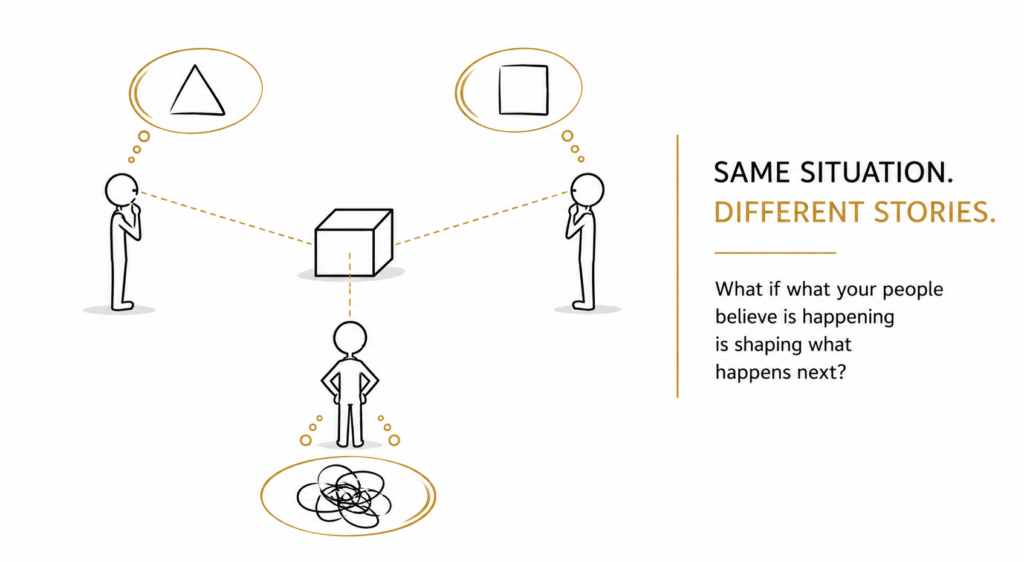
WHAT PEOPLE BELIEVE IS HAPPENING SHAPES WHAT HAPPENS NEXT.
The same situation can produce very different responses depending on the assumptions, meaning and conclusions people bring to it.
That shows up in behaviour, conversations, decisions and ultimately, performance.
WHAT PEOPLE BELIEVE IS HAPPENING SHAPES WHAT HAPPENS NEXT.
The same situation can produce very different responses depending on the assumptions, meaning and conclusions people bring to it.
That shows up in behaviour, conversations, decisions and ultimately, performance.
WHY IT MATTERS TO YOUR ORGANISATION
YOU CAN’T TRAIN PEOPLE FOR EVERY SITUATION THEY’LL FACE.
BUT YOU CAN STRENGTHEN HOW THEY THINK THROUGH THEM.
BUT YOU CAN STRENGTHEN HOW THEY THINK THROUGH THEM.
Different people. Different pressures. Different situations.
You can’t predict every difficult decision, relationship, setback or challenge your people will encounter. Master Your Mind™ develops something transferable: the ability to question their interpretation, regain clarity and determine what to do next.
The situation changes. The capability stays with them.

WHY IT MATTERS TO YOUR ORGANISATION
YOU CAN’T TRAIN PEOPLE FOR EVERY SITUATION THEY’LL FACE.
BUT YOU CAN STRENGTHEN HOW THEY THINK THROUGH THEM.
BUT YOU CAN STRENGTHEN HOW THEY THINK THROUGH THEM.
Different people. Different pressures. Different situations.
You can’t predict every difficult decision, relationship, setback or challenge your people will encounter. Master Your Mind™ develops something transferable: the ability to question their interpretation, regain clarity and determine what to do next.
The situation changes. The capability stays with them.
LEARN IT ONCE. APPLY IT AGAIN AND AGAIN.
Master Your Mind™ is a practical half-day workshop. Participants bring something real that is occupying their thinking and learn the framework by applying it to their own situation.
REAL SITUATION
Work with something real rather than a hypothetical exercise.
APPLIED LEARNING
Learn the framework by applying it privately to your own situation.
REUSABLE CAPABILITY
Leave with a framework you can apply when the next decision, problem or difficult situation arises.
For your organisation, that means people better equipped to think through problems independently, exercise sound judgement and take ownership of what happens next.
LEARN IT ONCE. APPLY IT AGAIN AND AGAIN.
Master Your Mind™ is a practical half-day workshop. Participants bring something real that is occupying their thinking and learn the framework by applying it to their own situation.
REAL SITUATION
Work with something real rather than a hypothetical exercise.
APPLIED LEARNING
Learn the framework by applying it privately to your own situation.
REUSABLE CAPABILITY
Leave with a framework you can apply when the next decision, problem or difficult situation arises.
For your organisation, that means people better equipped to think through problems independently, exercise sound judgement and take ownership of what happens next.
DIFFERENT SITUATIONS. ONE TRANSFERABLE CAPABILITY.
A difficult relationship. A decision you keep circling. Conflict with a colleague. A setback. Uncertainty. A situation that simply isn’t going the way you expected.
“THEY’RE UNDERMINING ME.”
THE SITUATION
A senior leader was struggling with a difficult working relationship. They had become convinced that the other person was deliberately undermining them.
So they began approaching each interaction expecting resistance. Challenges reinforced what they already believed, conversations became more defensive and the relationship deteriorated.
WHAT CHANGED
Working through what was bothering them allowed the leader to separate what had actually happened from everything they had concluded it meant.
The relationship was difficult. What they could not actually know was that the other person was deliberately trying to undermine them.
WHAT THEY DID NEXT
Once they could see the situation differently, they stopped building their response around an intention they could not know was true and developed a different strategy for addressing what was actually happening.
“I DON’T WANT TO DAMAGE THE RELATIONSHIP.”
THE SITUATION
A senior leader had a good working relationship with a colleague, but there was an issue they knew needed to be addressed.
What was bothering them was not whether there was a problem. It was what addressing it might do to a relationship they valued.
WHAT CHANGED
Working through the situation separated the issue that genuinely needed attention from what they feared addressing it might mean for the relationship.
Having a good relationship did not make the issue disappear.
WHAT THEY DID NEXT
With the situation clearer, the leader addressed the issue directly, gave the feedback that was needed and established clearer expectations and boundaries.
“THEY NEED TO STEP UP.”
THE SITUATION
A portfolio manager was frustrated by how much kept landing on his desk. He was giving more direction than he thought he should, and some team members were not showing the initiative he expected.
From where he was sitting, the problem seemed clear: they needed to step up.
WHAT CHANGED
Some people did need to show more initiative. But that was not everything that was true.
He could also see what the team was experiencing from him: his tone, the relationships he had built, the expectations he had not made explicit and assumptions about what people understood or had capacity to deliver.
He had become so focused on the outcome he wanted that he had overlooked some of what needed to happen between giving an instruction and getting the result.
WHAT THEY DID NEXT
He stopped asking only what the team needed to change and became more deliberate about what he needed to change to help create the outcome he wanted.
DIFFERENT SITUATIONS. ONE TRANSFERABLE CAPABILITY.
A difficult relationship. A decision you keep circling. Conflict with a colleague. A setback. Uncertainty. A situation that simply isn’t going the way you expected.
“THEY’RE UNDERMINING ME.”
THE SITUATION
A senior leader was struggling with a difficult working relationship. They had become convinced that the other person was deliberately undermining them.
So they began approaching each interaction expecting resistance. Challenges reinforced what they already believed, conversations became more defensive and the relationship deteriorated.
WHAT CHANGED
Working through what was bothering them allowed the leader to separate what had actually happened from everything they had concluded it meant.
The relationship was difficult. What they could not actually know was that the other person was deliberately trying to undermine them.
WHAT THEY DID NEXT
Once they could see the situation differently, they stopped building their response around an intention they could not know was true and developed a different strategy for addressing what was actually happening.
“I DON’T WANT TO DAMAGE THE RELATIONSHIP.”
THE SITUATION
A senior leader had a good working relationship with a colleague, but there was an issue they knew needed to be addressed.
What was bothering them was not whether there was a problem. It was what addressing it might do to a relationship they valued.
WHAT CHANGED
Working through the situation separated the issue that genuinely needed attention from what they feared addressing it might mean for the relationship.
Having a good relationship did not make the issue disappear.
WHAT THEY DID NEXT
With the situation clearer, the leader addressed the issue directly, gave the feedback that was needed and established clearer expectations and boundaries.
“THEY NEED TO STEP UP.”
THE SITUATION
A portfolio manager was frustrated by how much kept landing on his desk. He was giving more direction than he thought he should, and some team members were not showing the initiative he expected.
From where he was sitting, the problem seemed clear: they needed to step up.
WHAT CHANGED
Some people did need to show more initiative. But that was not everything that was true.
He could also see what the team was experiencing from him: his tone, the relationships he had built, the expectations he had not made explicit and assumptions about what people understood or had capacity to deliver.
He had become so focused on the outcome he wanted that he had overlooked some of what needed to happen between giving an instruction and getting the result.
WHAT THEY DID NEXT
He stopped asking only what the team needed to change and became more deliberate about what he needed to change to help create the outcome he wanted.
THE REAL VALUE IS WHAT PEOPLE CAN DO FOR THEMSELVES.
The situations were different. The capability was the same: question what is driving the response, get clear on what the situation requires and determine what to do next.
The next situation may be different. The capability goes with them.
PRACTICAL. STRUCTURED. BUILT FOR WORK.
Master Your Mind™ is a practical thinking framework designed for the workplace. There is no diagnosis, no forced disclosure and no requirement for participants to share personal experiences with the room.
Participants work privately on their own situation while developing a capability they can use again and again.
The Moment the Problem Changes, Everything Else Can Too.

BRING MASTER YOUR MIND™ TO YOUR ORGANISATION
GIVE YOUR PEOPLE A THINKING CAPABILITY THEY’LL KEEP USING.
One half-day workshop. A practical framework your people can apply to the next problem, decision or difficult situation they face.
FAQ –
What workplace situations can people use Master Your Mind™ for?
The framework isn’t tied to one type of workplace problem. It is designed for the moments when someone is stuck, reacting, overthinking or struggling to see a clear way forward.
That might include a difficult conversation, a decision they cannot resolve, conflict with a colleague, frustration with a manager, a confidence issue, resistance to change, a recurring behaviour or a situation that is affecting them more than they understand.
Rather than starting with the obvious problem, the framework helps them cut through the noise, get to the heart of what is driving it and build a practical strategy for what to do next.
Who is the Master Your Mind™ workshop suitable for?
Master Your Mind™ can be used by employees, managers and leaders. The situation they bring may be different; the capability they learn is transferable.
It can therefore work as part of employee development, management and leadership development, behavioural skills training or wider L&D programmes.
The workshop can also be tailored to the organisational context while keeping the core Master Your Mind framework consistent.
What happens during the workshop — and do people have to share their problem?
Participants don’t spend the day listening to theory or working through generic case studies. They learn From Master Your Mind™ by using it on a real situation that matters to them.
They are guided through the framework, experience the difference it makes and practise applying it so they can use it again after the workshop.
Participants remain in control of what they disclose. They do not need to share the details of their situation with the group.
This is practical workplace development, not therapy or group counselling.
How many people can attend and what is the workshop format?
Master Your Mind™ is a practical half-day face-to-face workshop designed to give participants enough time to learn the framework, apply it and practise using it.
For the most interactive experience, groups of 5–16 participants is recommended.
Much larger groups can also be accommodated, with the format adapted to suit the size of the group and your organisation’s requirements.
How much does a Master Your Mind™ workshop cost?
In-person Master Your Mind™ workshops start from £2,500 + VAT.
The final investment will depend on group size, location and whether you are looking for a standalone workshop or delivery across multiple cohorts.
For organisations considering a wider rollout, I can build a tailored programme and proposal around your requirements.

Psychology-based leadership coaching to break patterns, reset thinking, and lead with clarity — in life and leadership.
Services
- Leadership Coaching
- Blocker to Breakthrough
- Power Hour - Coming Soon
Useful Links
Socials
Copyright © 2025 Rakhi Method
Before You Change the Outcome, Find What’s Driving It.
If the response is being driven by the wrong conclusion, changing the behaviour won’t solve it.
Start further back. Separate what happened from what was assumed, predicted or believed about it. Then identify what is actually driving the response.
That is where better judgement begins. Because when people can see the difference between fact and interpretation, they are far more likely to choose a response that fits the situation they are actually dealing with.


CHANGE THE OUTCOME